Complex Systems Digital Campus
CS-DC UNESCO UniTwin
Worldwide Wellbeing DAO introducing its DAICO :
the DaD (Decentralized
application Data) Token
An introduction for Ethereum Investors
Overview
The WW DAO proposes a massive paradigm shift in the way people use ‘free’ internet services and the way that service providers collect and exploit data provided by their users. Currently service providers earn billions of dollars from the data they collect on their centralized servers and individuals have no guarantee on how their data are ethically used.
The WW DAO is creating a new token for its individual members along their supply chains, the DaD (Decentralized application Data): the DaD as a capital is the personal data roadmap that people own and store locally from the WW Dapp (Decentralized application). They give or refuse permission through a smart contract on how their data will be used. The CS-DC is creating the WW DAO for federating individual members to share their DaDs with science and service providers as societal partners: both will use the scientific DaDs syntheses for their individual or societal ‘smart’ roadmap. ‘Smart’ means ‘mutual wellbeing’ as defined by the 17 UN Sustainable Development Goals (SDGs). Only science can release the huge added value of DaDs by the provision of a DAD dividend from the service provider to the individual members as a universal right.
In this huge WW DAO, smart contracts as algorithms have to do what they are believed to do, e.g. have to adhere exactly the specifications voted by DAO sovereign assemblies: this kind of decentralized control avoids any risk of non ethical use of personal data by bringing ‘trust in algorithms’.
The Complex Systems Digital Campus (CS-DC)
The CS-DC is a UNESCO UniTwin (“University Twinning”) - a network of 131 Universities having signed with the Director of UNESCO a Cooperation Programme for launching worldwide a new scientific discipline. The Complex Systems Digital Campus is the UNESCO UniTwin devoted to share all the resources for launching complex systems science with special attention to the UN Agenda for 2030, as stated in its Cooperation Programme with UNESCO. The objective for the two next years is to have several thousand universities covering all countries.
The WW DAICO
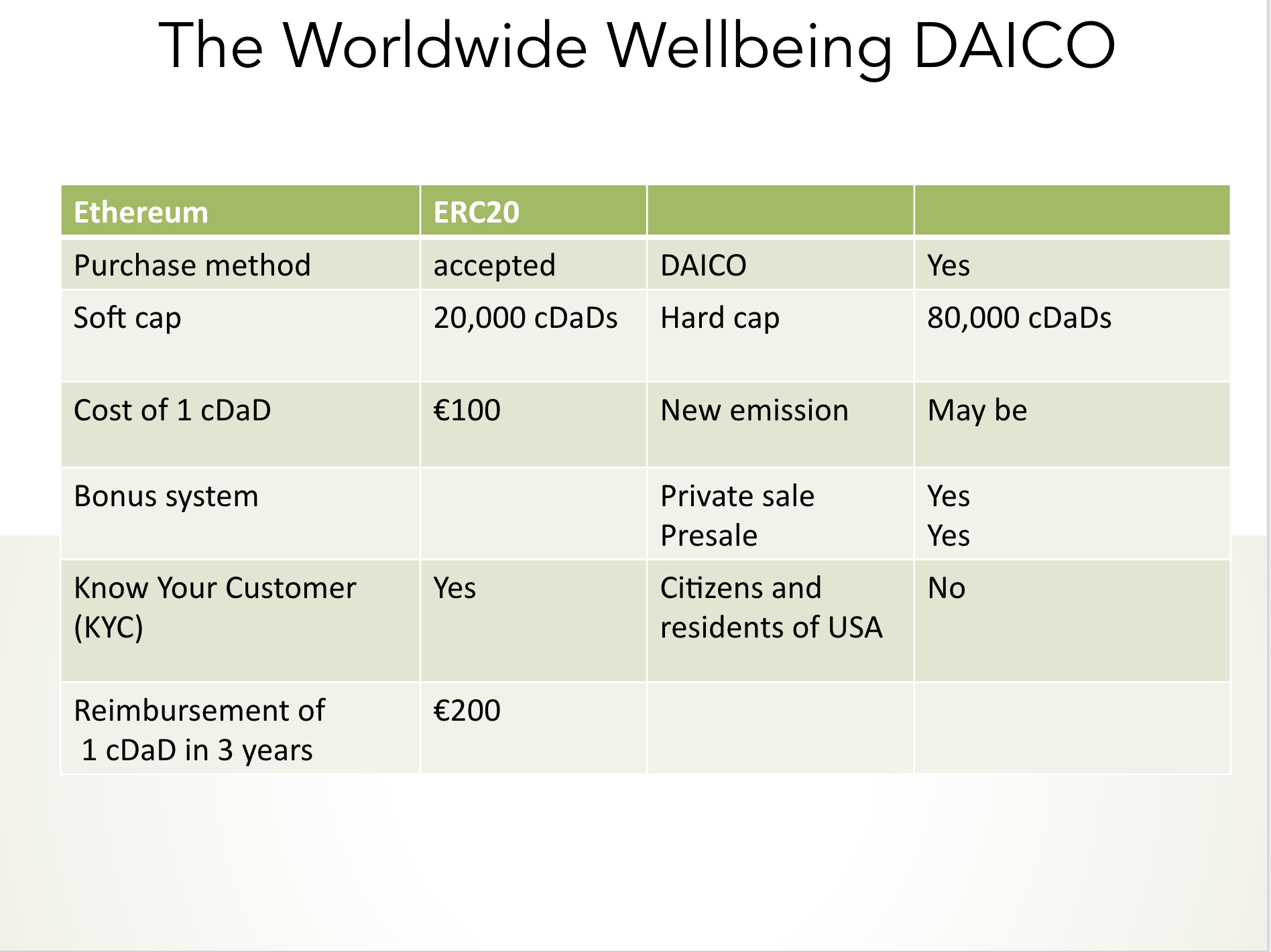
The main rules of the DAICO are as follows:
- There is an Investor Committee that can decide by a majority vote to stop the DAICO before the 3 first years: in such case, the investors are reimbursed proportionally to their initial contributions. This committee will be involved in the enlargement of the WW DAO principles for other new huge DAO of DAOs.
- The DaD (and the centi-DaD) are reimbursed twice after 3 years, according to the expected doubling of the DaD value as a capital.
- If the WW DAO income is not sufficient, the reimbursement will be proportional to the individual investment
- A new DAICO will be launched with the ‘same doubling rule in a further 3 years’ if necessary and after a discussion with the Investor Committee.
The low soft cap is for starting as quick as possible, e.g. during the private sale
Smart Individual Roadmap (1)
Resilience problem 1:
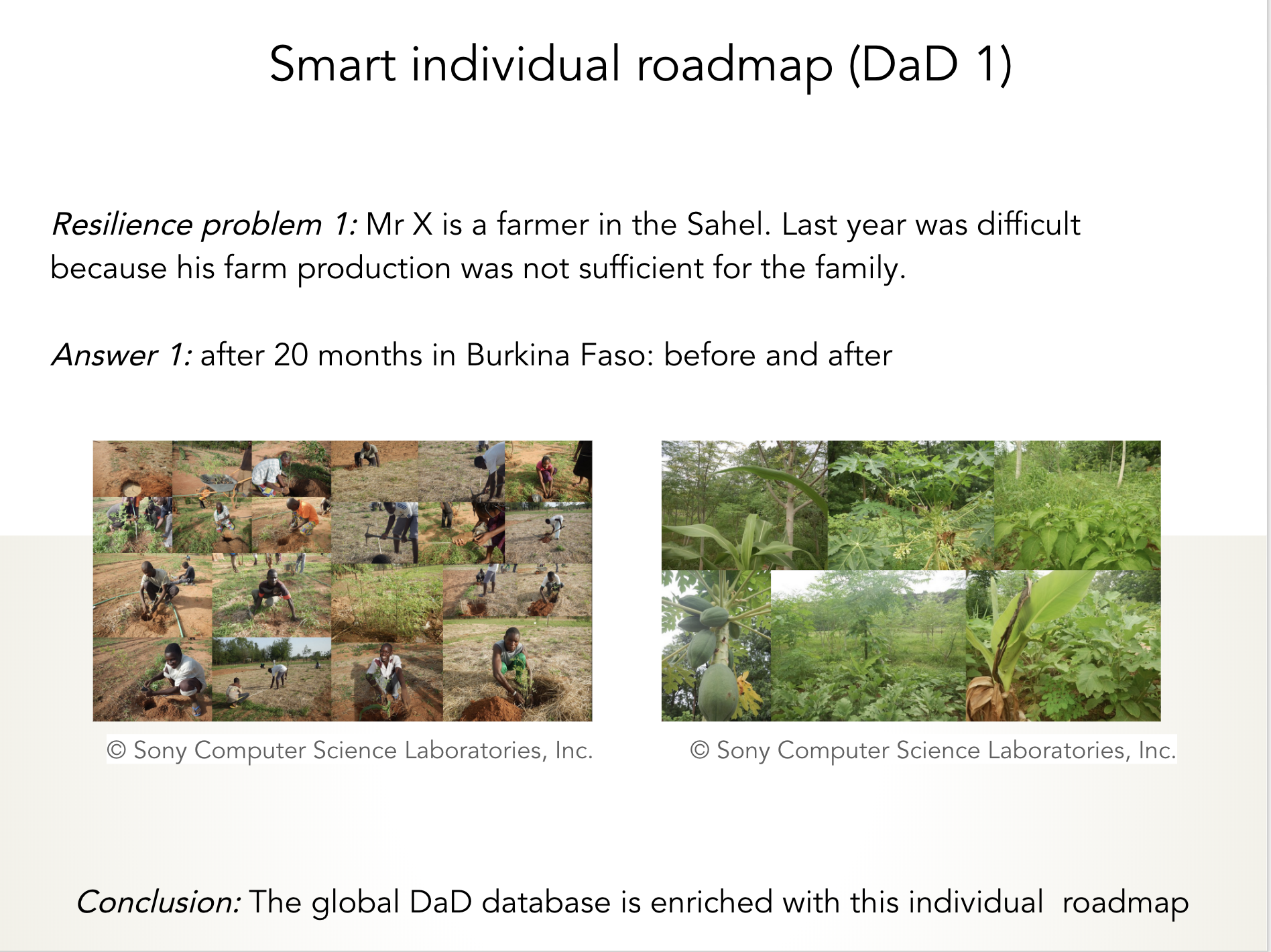
Mr X is a farmer in the Sahel. Last year was difficult because his farm production was not sufficient for the family. His ‘roadmap’ will be a path towards a sustainable source of food for him, his spouse and four children.
Answer from the WW Dapp:
Please look at these examples of synecoculture in Burkina Faso. Do you want to enter in relation with farmer close to you for more information? The WW Dapp will help him develop his roadmap as a personalised programme of action to achieve his goals. During this he will provide data on what he does and his results (personal trajectory) that helps to improve the Dapp, services and increase their added value...
Smart Individual Roadmap (2)
Resilience problem 2:
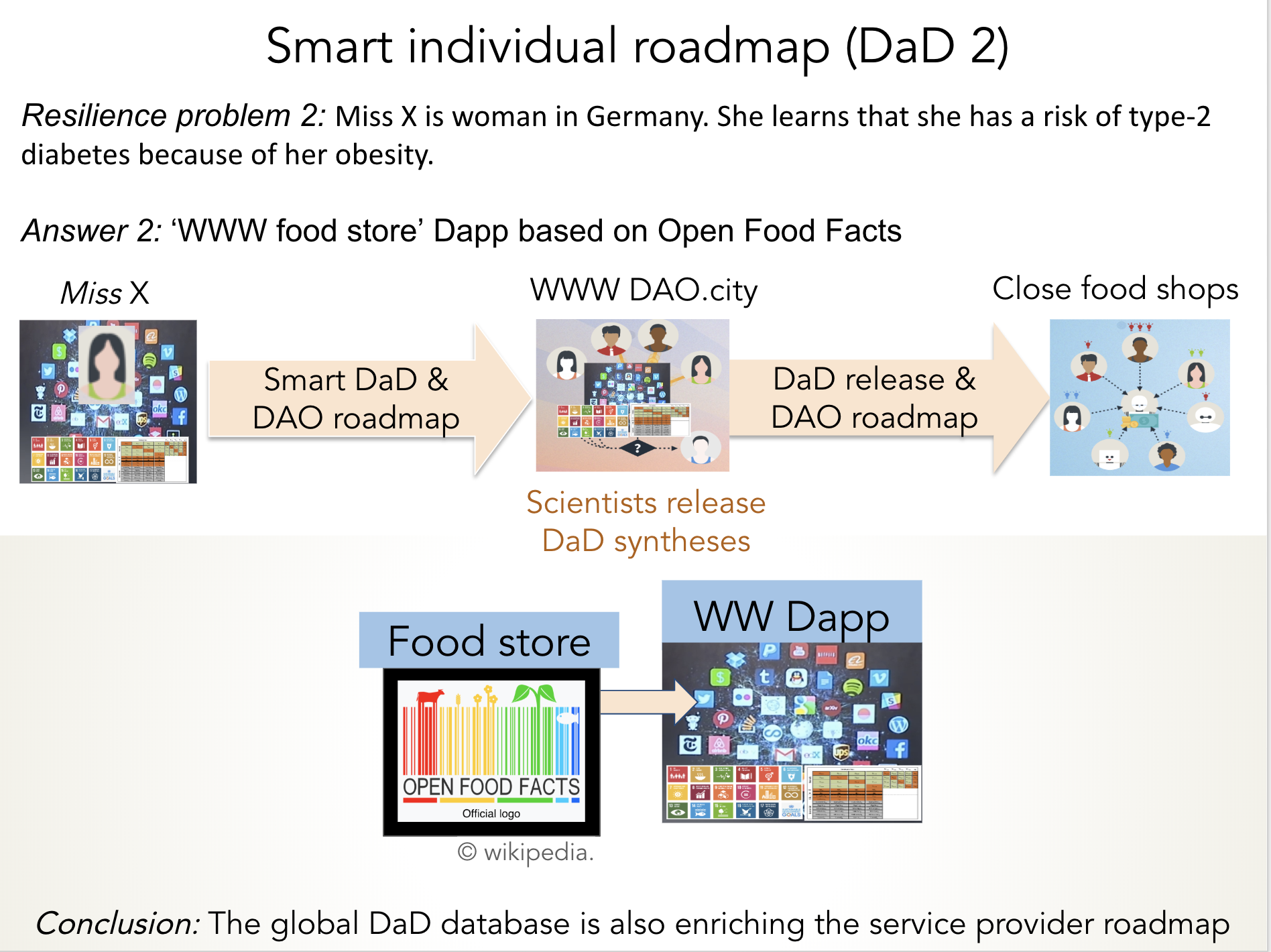
Miss X is woman in Germany. She learns that she has a risk of type-2 diabetes because of her obesity. Her ‘roadmap’ is to lose weight to reduce her obesity and risk of diabetes. She joins the WW Dapp to find out how to do this. The WW Dapp will help her develop her personal roadmap including providing information about diabetes and suggesting personalised diets for her roadmap treatment programme. As this programme progresses she will provide data on her weight and other health related things. This personal DaD helps her get personalised recommendation, and contributes to the global DaD database.
Answer from the WW Dapp:
To improve your health please look at the following food stores close to you that have adopted the ‘WW food store’ application. With ‘WW food store’, you can request your diet, e.g. for each week. The Dapp will verify online by using the Open Food Facts database that i) what you eat is suitable for your personal diabetes risk and health in general and ii) that the total of calories is in agreement with your plan for losing weight, and respects your personal tastes. Further, it may propose substitutions of equivalent or better products based on substitutions done by people in your situation.
The DaD dividend
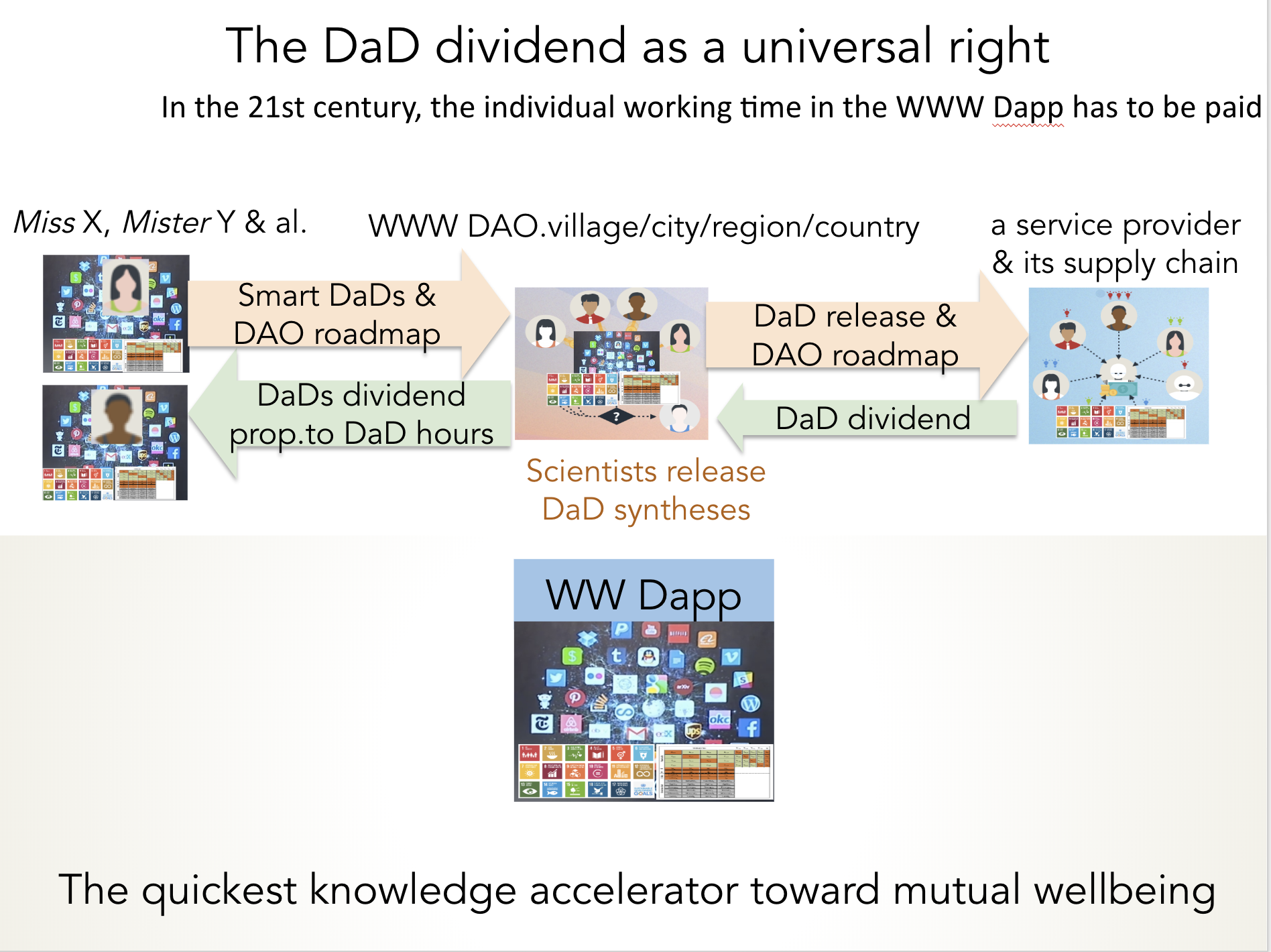
Miss X, Mr Y and all the other members produce with the WW Dapp their ‘individual roadmaps (DaDs)’ through their working time, measured by their ‘DaD hours’. As members of their WW DAO/territory, they have signed the ‘ethical’ smart contract: ‘sharing my smart DaD with science for social learning providing my smart personalized roadmap and receiving my DaD dividend, as a universal right, proportionally to my WW Dapp working time’. The virtuous cycle of the social learning provides smarter and smarter advices for smarter and smarter DaD: it constitutes the quickest knowledge accelerator toward mutual wellbeing.
Any service provider of the territory can benefit by engaging itself in another ethical smart contract: ‘designing with my clients my smart roadmap for mutual wellbeing by releasing with Science the huge added value of their anonymized DaDs and, thus, rewarding such release by a DaD dividend ’. Furthermore, such a living roadmap can create a cascade of new engagements and living roadmaps within its supply chains with a return cascade of similar DaD Dividends: it is like a social Value Added Tax (VAT), and thus economically neutral, i.e. not changing agent decisions..
The WW DAO/territory uses the DaD Dividend to pay for the value added by Science (e.g. 20%) and pay the members (e.g. 80%) proportionally to their DaD hours (working time, up to last decile of hours distribution) after deduction of their Ethereum micropayments. This proportionality fixes the value of the DaD per hour.
Two development phases
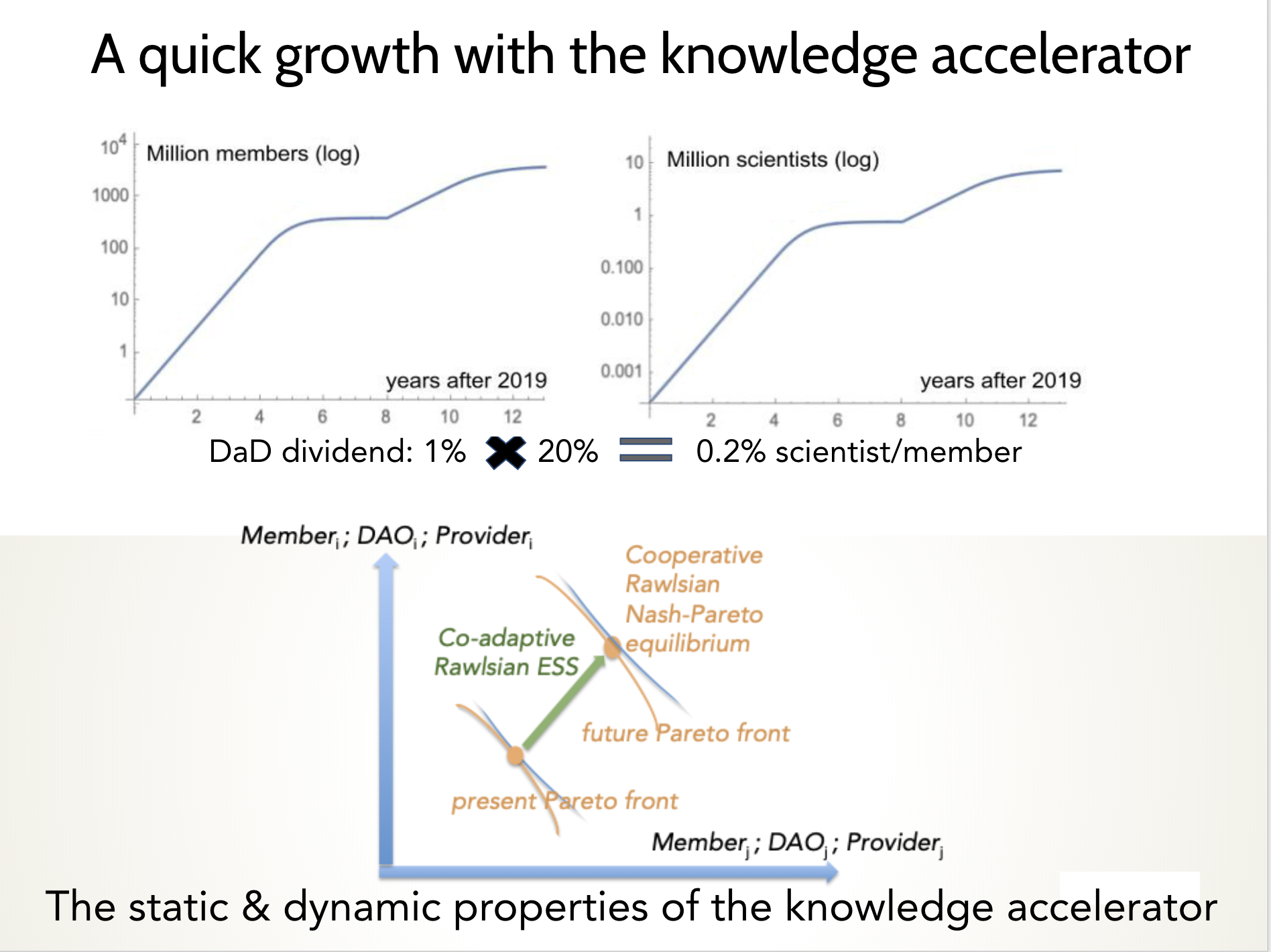
(Left Chart) The membership curve suggests a development as quick as other social networks
before 2025: indeed the WW DAO will have the basic attractive features of a social network; BUT, in
supplement, the wellbeing knowledge accelerator gives an adaptive advantage and rapid diffusion to
involved individuals and service providers. At a conservative estimate similar to classical social
network growth, there will be 600M members in 10 years.
(Right Chart) The scientific
membership curve is obtained by multiplying the membership curve by 0.2%. Indeed it is expected that
the personal DaD dividend will be at least 1% (the amount often paid by Service providers as
dividend to loyal clients). Now 20% of this 1% is a 0.2%.
It is expected that the second phase will start with the preparation of the next roadmap of UN after 2030 and with a ‘DaD dividend’ close to a mean salary per hour, i.e. the order of magnitude more of 10% of a mean annual revenue. The contribution to science could decrease from 20% to 2%, giving the same 0.2% scientist/member. Notice here that the 10% have economic neutrality like a ‘social VAT’ and will be like an additional revenue proportional to the DaD hours, i.e. to the present personal difficulties .. that is as Rawlsian as a health care ecosystem.
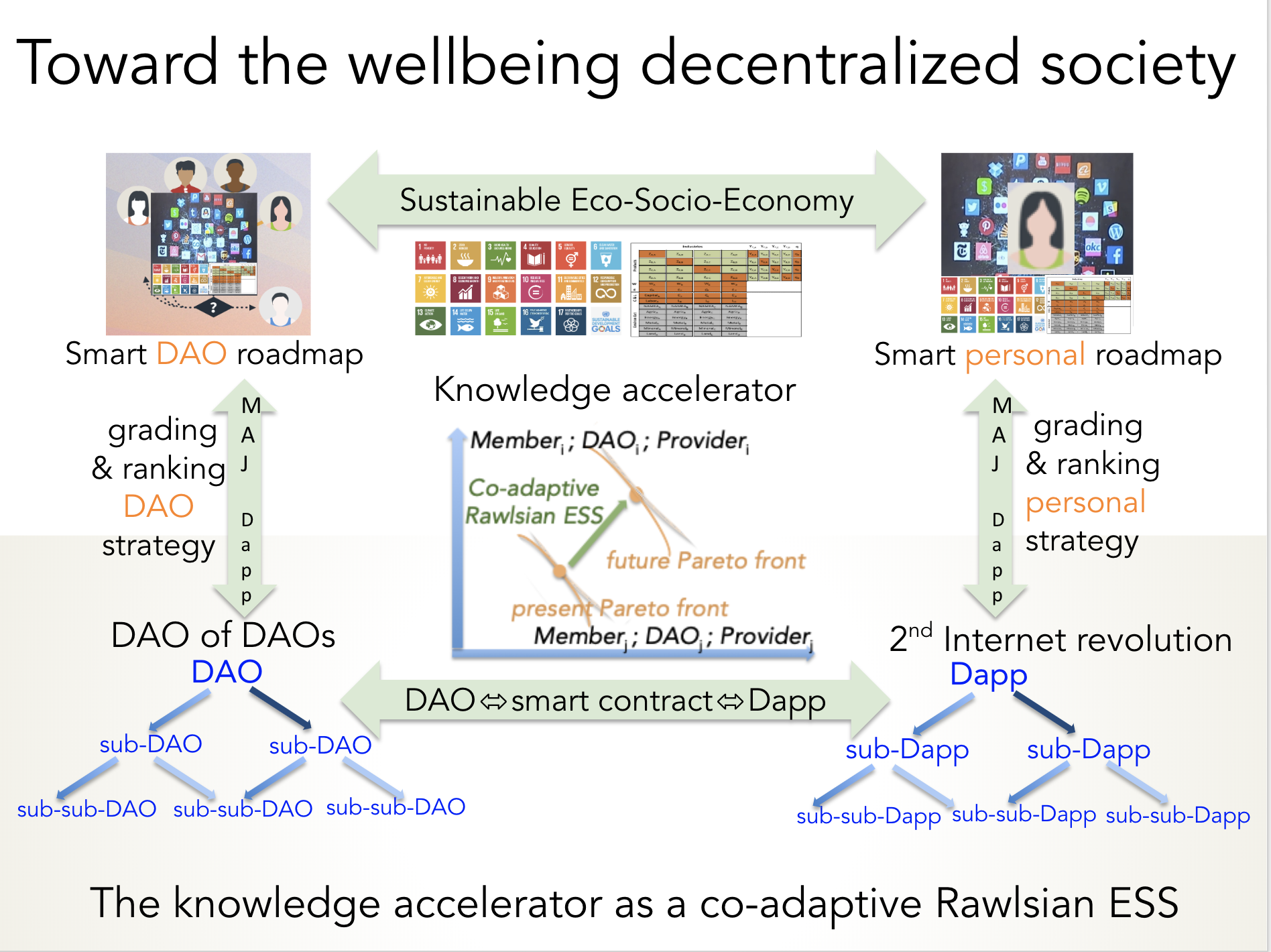
(Bottom Chart) The static and dynamic properties of the quickest knowledge accelerator strategy: this strategy is transforming into a dynamic co-adaptive Rawlsian ESS (Evolutionary Stable Strategy) the unique static ‘cooperative Rawlsian Nash-Pareto equilibrium’: the equilibrium moves with the evolution of the Pareto front in a rapidly changing world. Coopetitive fair interactions with Prizes remain amongst the different categories: members, sub-territorial DAOs or service providers in the same branch.
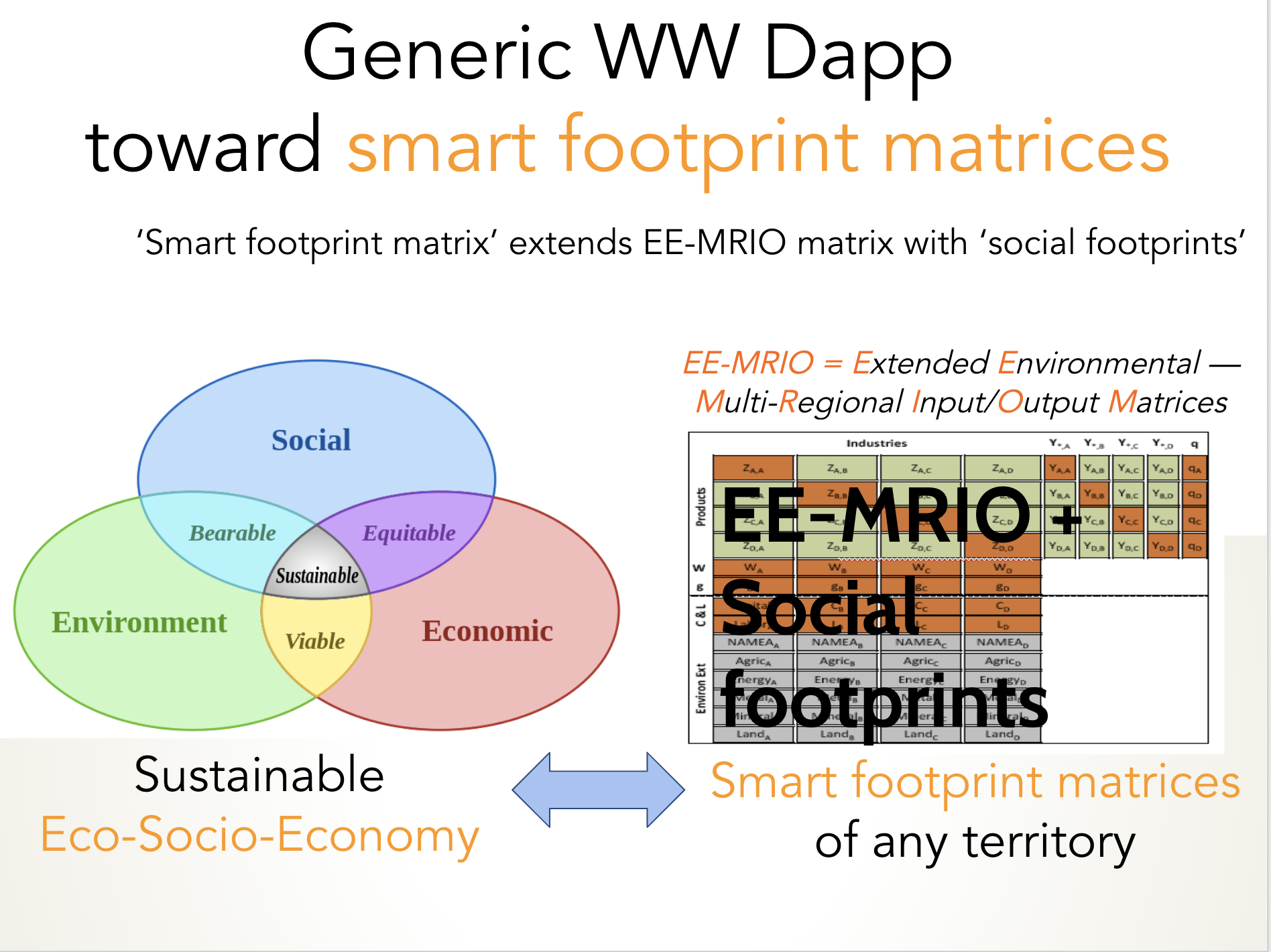
Sustainable Eco-Socio-Economy
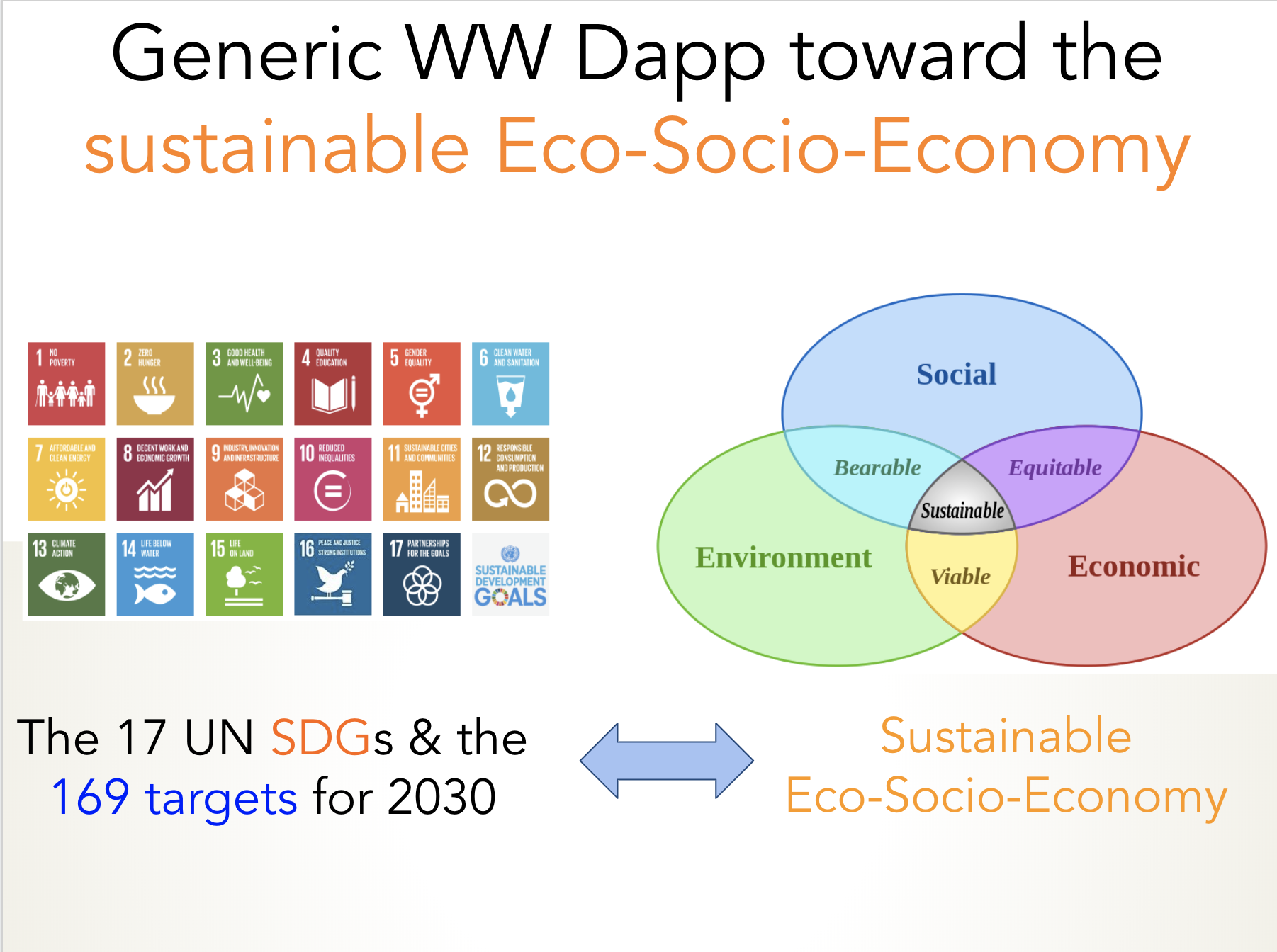
The 17 SDGs of United Nations and their 169 targets for 2030 are well equilibrated between ecological, social and economical objectives toward an Eco-Socio-Economy of mutual well-being between humans and with Nature. They act in the same direction as some deep emergent forms of economy like the coloured ellipses, the green, the blue, the sharing, the social & welfare Economy.
The 17 SDGs are:
- No poverty
- Zero hunger
- Good health and well-being
- Quality education
- Gender equality
- Clean water and sanitation
- Affordable clean energy
- Decent work and economic growth
- Industry, innovation and infrastructure
- Reduced inequalities
- Sustainable cities and communities
- Responsible consumption and production
- Climate action
- Life below water
- Life on land
- Peace justice and strong institutions
- Partnerships for the goals
The 169 targets poster includes interactions between the SDGs. The generic WW Dapp will be developed by using all the scientific work done on the 17 UN SDGs and the 169 targets with their interactions.
Smart footprint matrices
EE-MRIO footprint matrices are calculated today only top down by taking the quantitative sectorial input, output and footprints with Nature (grey-lines: metals, fossil energy, CO2, water, soil occupation, ..) as the division of financial value by their mean prices. Results for 43 countries can be found in the exiobase. With the WW DAO, the smart footprint matrix of a territory:
- extends the grey lines with the social footprints from the 17 UN SDGs (e.g. food quality, disease, neuroleptic, suicide, infant education and lifelong education, ..)
- is calculated bottom-up along supply chains and their means in a sector will be simply physically weighted by the quantities. Such bottom-up computation needs the 2nd internet revolution and accumulator protocols (such as ERC20) for each kind of material or social footprint.
The ‘smart roadmaps’ from individual to territories through service providers and their supply chains will be directly expressed as ‘smart footprint matrices’. The smart footprint of a territory is physically aggregating those of its sub-territories.
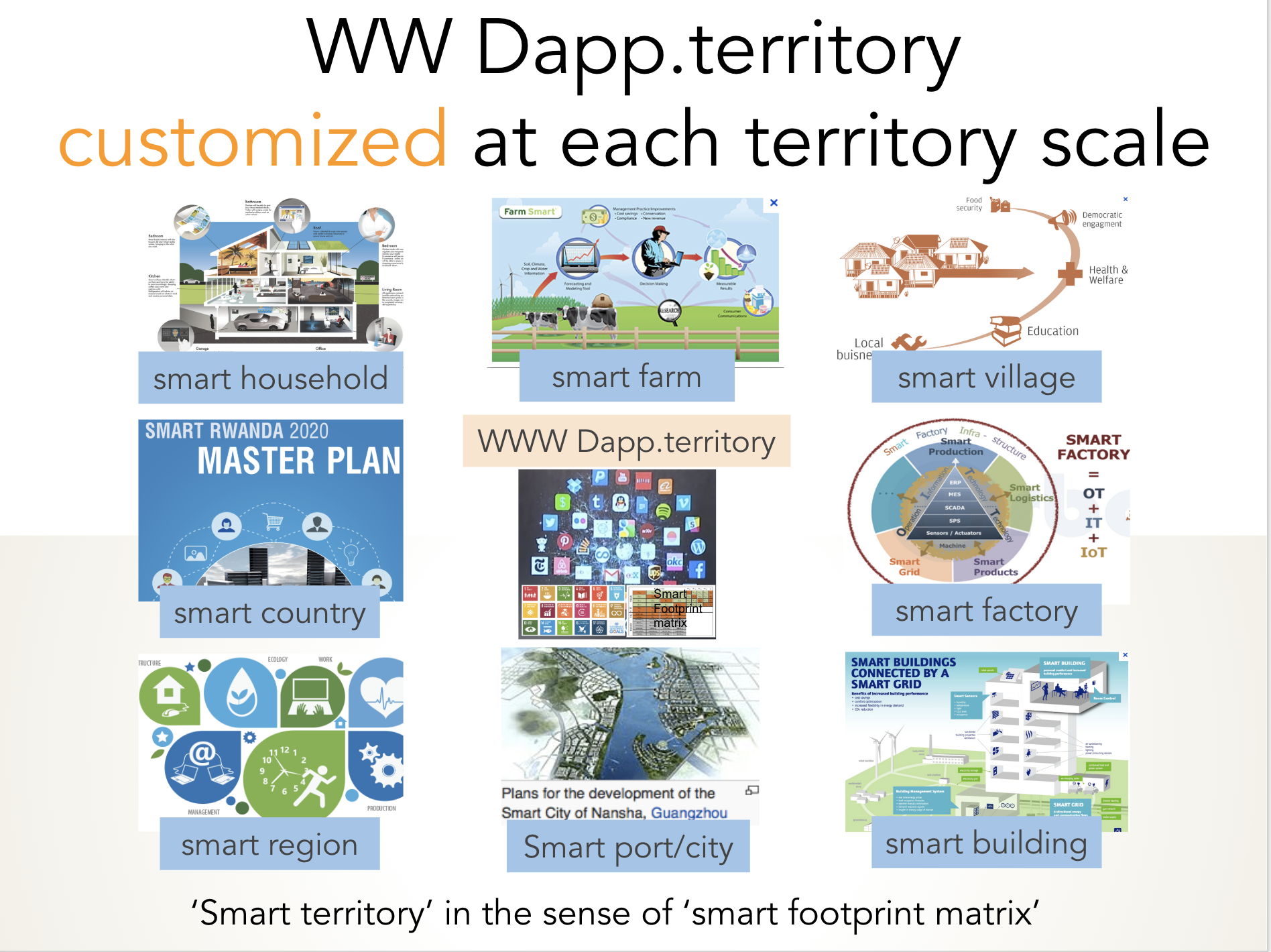
WW Dapp.territory
Each territory is ‘smart’ in the sense of ‘compatibility with and respecting the constraints of the 17 UN SDGs’, i.e. having a ‘smart footprint matrix’ more respectful of Nature and the Social. The customization of the WW Dapp by any WW DAO/territory will at least:
- take into account the languages, pictures and movies of the regions in the world, including those of primary people that are covering a large part of the continents and contains a great biodiversity,
- need to order the SDGs and targets adapted to the territory priority.
This customization of the WW DAO will represent, along the territory cascade, a progressive cascade of scientific efforts one order of magnitude more than the implementation of the generic WW Dapp.
Toward the whole decentralized society
Two main opportunities open up a highway toward the decentralized society for mutual wellbeing by launching the quickest knowledge accelerator
- Majority Judgment theory and its MAJ Dapp opens a new highway for grading and ranking all kind of social choices in smart contracts and their design
- The 2nd internet revolution is the way to decentralize all computations as if one is interacting with a single informational ecosystem.
The traditional theory of social choice has paradoxes such as those of Condorcet’s or Arrow’s. Arrow’s Theorem says that, for more than two choices, there exists no aggregation function of individual choices except the preference of one individual, the ‘dictator’. Such impossibility is consonant with a ‘centralized society’. In Arrow’s approach, voters directly ‘rank’ the competitors. The Majority Judgment theory of Balinski and Laraki removes this impossibility (see the note of WW DAO as a SIRE).
All the main Dapps of the WW DAO are well theoretically grounded (see the White paper). It is expected that the work with the DAICO investment committee will create some blogs and working groups generalizing the experience of the WW DAO toward the whole decentralized society.